Low Energy, Low Drive: Is It Your Hormones?
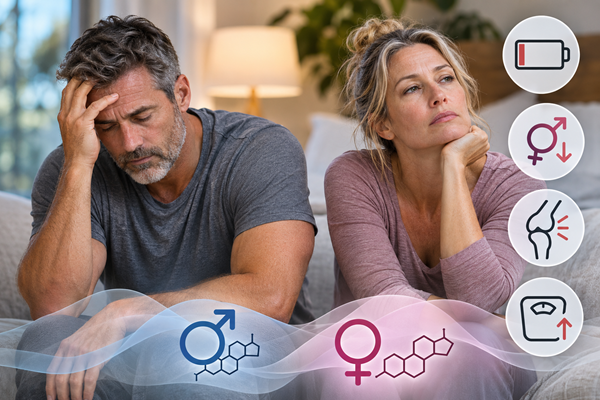
You sleep a full night and still wake up tired. Coffee barely helps. By mid-afternoon you’re dragging, your workouts feel harder than they used to, and your interest in sex has quietly disappeared. You might also notice your joints ache more, your mood is shorter and the weight is creeping on, even though you haven’t changed much.
It’s easy to blame a busy life, and sometimes that’s the answer. But for many adults, low energy and low drive are signs that hormones have shifted. In men, the usual suspect is low testosterone. In women, it’s often falling estrogen during perimenopause and menopause. And because hormones affect inflammation, these changes can show up as joint pain too.
Here’s what to watch for, what else can cause the same symptoms, and why lab testing is the only way to know for sure.
Signs of low testosterone in men
Testosterone does much more than drive libido. It helps you build and keep muscle, keeps bones strong, supports red blood cell production, and plays a big part in energy and mood.
Levels naturally drift down with age, by roughly 1% a year starting somewhere in your 30s or 40s. For most men, that slow decline doesn’t cause problems. For others, levels drop low enough to change how they feel day to day.
Common signs of low testosterone (low T) include:
Low sex drive, fewer morning erections or trouble with erections
Fatigue and less stamina than you used to have
Losing muscle strength, even if you still work out
More belly fat
Low or irritable mood
Trouble focusing or remembering things
The sexual symptoms are the most telling. Fatigue and brain fog on their own have many possible causes, which is why a blood test matters (more on that below).
Low T is also closely tied to weight and blood sugar. Carrying extra weight or having type 2 diabetes is one of the most common reasons for low testosterone in men, and low testosterone can make it harder to lose weight. It’s a cycle that’s hard to break without addressing both sides.
Women need testosterone too
Testosterone isn’t only a male hormone. Women make it in smaller amounts, and it supports sex drive, muscle and bone health, mood and energy. Levels fall gradually with age and can drop further after menopause or surgical removal of the ovaries. So if you’re a woman with low drive and low energy, testosterone may be worth checking along with estrogen.
Low estrogen in women: perimenopause and menopause
For women, the biggest hormone shift usually starts in the 40s with perimenopause, the years leading up to your final period. Estrogen doesn’t fall in a smooth line. It swings up and down, sometimes sharply, and those swings can be harder on your body than the lower, steadier levels after menopause.
Low or fluctuating estrogen can cause:
Fatigue that doesn’t match how much you’re doing
Hot flashes and night sweats that wake you up
Trouble falling or staying asleep
Mood swings, anxiety or feeling flat
Brain fog and forgetfulness
Lower sex drive and vaginal dryness
Weight gain around the middle
New aches in your joints and muscles
Sleep is a big piece of the energy puzzle. When night sweats wake you two or three times a night, you lose the deep sleep your body needs to recover. Over weeks and months, that adds up to exhaustion, a shorter fuse and more sensitivity to pain.
Many women are told this is “just part of getting older” and that they need to push through. But these symptoms have a clear hormonal cause, and for many women, hormone replacement therapy (HRT) can bring real relief when it’s matched to their labs, history and goals.
The hormone, inflammation and joint pain connection
If your knees, hips, hands or shoulders started aching around the same time your energy dropped, that may not be a coincidence.
In women, estrogen helps keep inflammation in check and supports cartilage and the tissues around your joints. When estrogen falls, inflammation can rise, and joints and muscles may feel stiff and sore. Research from Mass General Brigham suggests more than 2 in 5 women have muscle or joint pain in the years around menopause. It often shows up in the hands, knees, hips, neck and lower back, and it can start in perimenopause, before periods stop.
In men, testosterone also has a calming effect on inflammation. Studies have found that men with low testosterone tend to have higher levels of inflammatory markers and higher rates of osteoarthritis. Researchers haven’t proven that low T directly causes joint pain, but the link is strong enough to look at hormones when aches come with other low T symptoms.
Both hormones also protect your bones and muscles. As levels drop, people lose muscle more easily and bone density can thin, which puts more load on joints and raises the risk of fractures and osteoporosis over time.
Then there’s the cycle: joints hurt, so you move less. Moving less leads to weight gain and stiffness. Extra weight lowers testosterone in men and adds stress to every joint. Breaking that cycle often means treating the hormones and the joints at the same time.
Other causes of low energy, and why labs matter
Here’s the tricky part: low hormones aren’t the only thing that can leave you tired, foggy and uninterested. Several other common conditions cause almost the same symptoms:
Underactive thyroid, which can also cause weight gain, feeling cold and dry skin
Low iron or anemia, especially in women who still have periods
Low vitamin B12 or vitamin D
Blood sugar problems, including prediabetes and type 2 diabetes
Sleep apnea, often signaled by loud snoring and waking up unrefreshed. It also lowers testosterone in men.
Depression, anxiety and chronic stress
Side effects of medications
Often it’s more than one. A woman in perimenopause might also be low in iron. A man with low testosterone might also have sleep apnea and rising blood sugar.
That’s why guessing doesn’t work, and why grabbing a “testosterone booster” or an online hormone quiz can send you in the wrong direction. The only way to know what’s driving your fatigue is a good conversation plus the right blood work.
If you have fatigue with chest pain, shortness of breath, a racing heartbeat or feeling like you might faint, get emergency care right away.
How Meradith finds the root cause
At Desert Shadows Chiropractic & Wellness, hormone care is led by Meradith McCortney, FNP-BC, a board-certified family nurse practitioner on our Integrative Medicine team.
Meradith doesn’t start with a prescription. She starts with your story: when the fatigue began, how you’re sleeping, what’s changed with your mood, weight, cycles or sex drive, and where you hurt. Then she orders labs that look at the whole picture, including hormones, thyroid, iron, vitamins and blood sugar.
“Tired all day, wide awake at night”
One pattern Meradith sees again and again, in both men and women:
“Patients come in exhausted. They don’t feel like doing much of anything during the day. Then they get into bed at night and can’t fall asleep.” — Meradith McCortney, FNP-BC
It seems backward. If you’re that tired, shouldn’t sleep come easily? But hormones help run your sleep cycle, so when they shift, that “tired but wired” feeling is common:
In women, falling progesterone and estrogen can make it harder to settle down at night, and hot flashes and night sweats can wake you once you do fall asleep.
In men, low testosterone and poor sleep feed each other. Short or broken sleep lowers testosterone, and low testosterone can make sleep lighter and less restful.
In both, stress hormones can get out of rhythm, leaving you sluggish in the morning and alert at bedtime.
The result is a cycle: poor sleep drains your energy, low energy means less activity, and less activity makes sleep worse. That’s why Meradith always asks about sleep, even when patients come in for something else.
What she often finds:
In women, low estrogen is a common driver of fatigue, poor sleep and new joint pain. For many women, HRT is the most effective way to restore balance, and Meradith tailors it to each patient’s labs, symptoms and health history.
In men, low energy is frequently tied to low testosterone. When labs and symptoms both point that way, testosterone therapy may be an option, along with addressing weight, sleep and blood sugar.
If the labs point somewhere else, like thyroid or iron, she treats that instead. The goal is to fix the cause, not cover up the symptom.
How Dr. Chris helps with the aches that come with it
Balancing hormones takes time, often weeks to months. Meanwhile, sore joints and a stiff back can keep you from moving, sleeping and feeling like yourself. That’s where chiropractic care with Dr. Chris Campo, D.C., fits in.
Chiropractic care doesn’t change your hormone levels. What it can do is ease the pain and stiffness that often show up alongside them, including:
Joint pain in the knees, hips and shoulders
Neck and lower back pain, which many women notice more in perimenopause and menopause
Tension headaches and tight muscles in the neck and shoulders
Stiffness that makes it hard to exercise or get comfortable at night
Less pain usually means better sleep and more movement, and both help your energy. Dr. Chris also gives you stretches and exercises to keep joints moving and muscles strong.
For patients with lower bone density from hormone changes, he adjusts his approach and uses gentle techniques. And because Meradith and Dr. Chris work under one roof, your joint care and hormone care can work together instead of in separate offices.
Feel like yourself again
Being tired all the time, losing your drive and aching more than you used to isn’t something you just have to accept. Whether it’s low testosterone, low estrogen or something else entirely, the first step is finding out what’s actually going on.
Want to see the other symptoms we help with? Hormone symptoms we treat → · Energy and sleep → · Joint pain →
Ready to get answers? Learn about hormone care with Integrative Medicine → or book a hormone consult with Meradith. For joint or back pain, book with Dr. Chris. You can also call our North Phoenix office at (602) 595-0015.
Sources
For your reference while editing. You can remove this section from the live post or keep it to show the research behind it.
Low Testosterone (Male Hypogonadism), Cleveland Clinic
Androgen Deficiency, Cleveland Clinic
Low Testosterone Treatment: Do You Need It?, Cleveland Clinic
Menopause and Joint Pain, Mass General Brigham
Low testosterone and osteoarthritis risk (NHANES 2011–2016), BMC Musculoskeletal Disorders, 2024
Lower testosterone levels may increase the risk of arthritis, Medical News Today
Fatigue: Causes, Mayo Clinic